From calls to knowledge: how Heydiga was born and how it works


In this article
- What is Heydiga and what do we do?
- How Heydiga’s voice AI works internally
- What we learnt building Heydiga
- DigaLook, DigaFood, and DigaMotor verticals
- DigaLook: for beauty and wellbeing
- DigaFood: for restaurants and organised catering
- DigaMotor: for workshops and dealerships
- Why does this matter?
- How collaboration with Heydiga usually begins
- Not sure if it will sound natural?
Introducing Heydiga: AI phone agents for salons, restaurants and workshops
Heydiga was born in the opposite place to where a technology company would normally be born: a workshop and a hairdresser's.
In the workshop, the phone rang while the mechanics repaired the car in front of them. In the hairdressing salon, the stylists interrupted their services to answer calls, confirm appointments or note changes in a notebook. Every missed call was a missed opportunity. Every interruption meant a slight drop in quality and customer service.
That friction gave rise to an idea: what if all those conversations could be handled properly, without interrupting anyone, and also leave a clear trail of what is happening in the business?
That is Heydiga today:
voice agents and conversation analysis that turn every interaction into a resolved task and actionable knowledge.
What is Heydiga and what do we do?
Heydiga is a voice AI and conversation platform for businesses that live from talking to their customers: hair and beauty salons, clinics, restaurants and restaurant groups, workshops, dealerships and multi-location service organisations in Spain and across Europe.
On a day-to-day level, it is quite simple to describe:
- When someone calls or writes, a Heydiga voice agent answers, understands what the person wants to do and acts accordingly: make a booking, change an appointment, request information, reschedule, resolve a query.
- While doing so, it follows the rules of the business: opening hours, capacity, gaps between services, staff availability, active campaigns.
- When the interaction ends, it leaves a structured record of what has happened: reason for contact, outcome, and relevant data for operations and marketing.
What used to be random calls and scattered messages becomes a repeatable process and a source of continuous learning.
How Heydiga’s voice AI works internally
The underlying technology is advanced, but the operational logic is straightforward.
When a call or message comes in, the agent identifies the main intent and the context. Booking a table for tonight is not the same as asking about a specific hair treatment, rescheduling a service in the workshop or notifying a delay. From there, the agent activates the appropriate flow, asks the necessary questions and guides the conversation towards a clear outcome.
To make those decisions, the agent is connected to the business tools: calendars, booking engines, salon software, dealer and workshop management systems. This allows it to offer only real time slots, to respect the constraints of each service and resource, and to apply policies that humans often have to carry in their heads.
The last step is one that is often missing in traditional operations: recording what happened in an orderly way. Not only how many calls were received, but why people called, what was resolved, what was lost and what patterns keep repeating. That is how each conversation contributes something to the business’ understanding of its own reality.
What we learnt building Heydiga
The first version of Heydiga was intentionally small. It focused on one thing: missed calls.
If a customer called a salon, a restaurant or a workshop and no-one could answer, the voice agent picked up, captured the essential information and ensured that no opportunity disappeared in silence. From there, more flows were added: bookings, changes, FAQs, triage.
A few principles from that journey are still core to the product:
- Start with the high-impact basics. First, make sure every call is answered and key tasks are handled reliably. Only then add edge cases.
- Build a modular architecture. There is a shared “brain” for understanding and conversation, and then vertical modules for beauty, food and motor that encode the specifics of each sector.
- Measure every interaction. Calls are evaluated in real time with guardrails and quality criteria, so the system can be improved call by call rather than left to run unchecked.
All customers benefit from the same core agent, and then each business or group adds their own rules, tools and nuances on top.
DigaLook, DigaFood, and DigaMotor verticals
On this common base, Heydiga builds sector-specific products. The needs of a restaurant group are not identical to those of a chain of salons or an automotive network, even if all three rely on the phone.
DigaLook: for beauty and wellbeing
In a salon, calls rarely arrive when the team is free. They come in the middle of a colour treatment, while a stylist is holding scissors, or just as someone is mixing product for the next client. In many businesses, there is also a constant thread of WhatsApps asking for last-minute changes, “quick” questions or early appointments.
DigaLook takes over that layer of organisation: appointments, changes, reminders and regular client management. The voice agent can explain approximate durations, take preferences into account, ensure the right professional is booked for each service and keep the calendar coherent without forcing the team to work with the phone in their hand.
In multi-centre groups, the advantage is twofold. There is a common standard of service and booking logic, but each location can keep its specific opening hours, services and resources.
DigaFood: for restaurants and organised catering
In restaurants, calls tend to cluster around a few themes: bookings, time changes, questions about menus or allergens, and last-minute requests for “just one more table”. Much of that demand arrives at the worst possible moments during service, when the team is already at full capacity.
DigaFood handles these conversations, both during opening hours and outside them. It checks actual availability, confirms what the business can realistically accommodate, and answers the questions that diners ask again and again.
For restaurant groups and multi-location hospitality organisations, this creates something that is often missing: a consistent way to manage reservations and calls across all locations, with comparable data between them.
DigaMotor: for workshops and dealerships
In automotive, a significant part of the work begins on the phone: pre-ITV inspections, regular servicing, tyre changes, diagnostics, vehicle tests.
DigaMotor helps ensure that these calls do not go unanswered or constantly pull technicians away from the workshop bay. The agent can collect the necessary details, suggest dates based on the real schedule, explain the procedure and classify the type of service before a person steps in, if needed.
The result is more effective time spent on vehicles and less time tied up on the phone, without losing information about why each customer is calling or what they expect.
Why does this matter?
Beyond the technology, what matters is what changes for those who operate a business or a network of centres.
Smoother operations
When calls no longer depend on “who happens to pick up the phone” and instead follow clear, well-designed processes, operations become more predictable. Booking or changing an appointment stops being a constant exception and becomes a controlled flow.
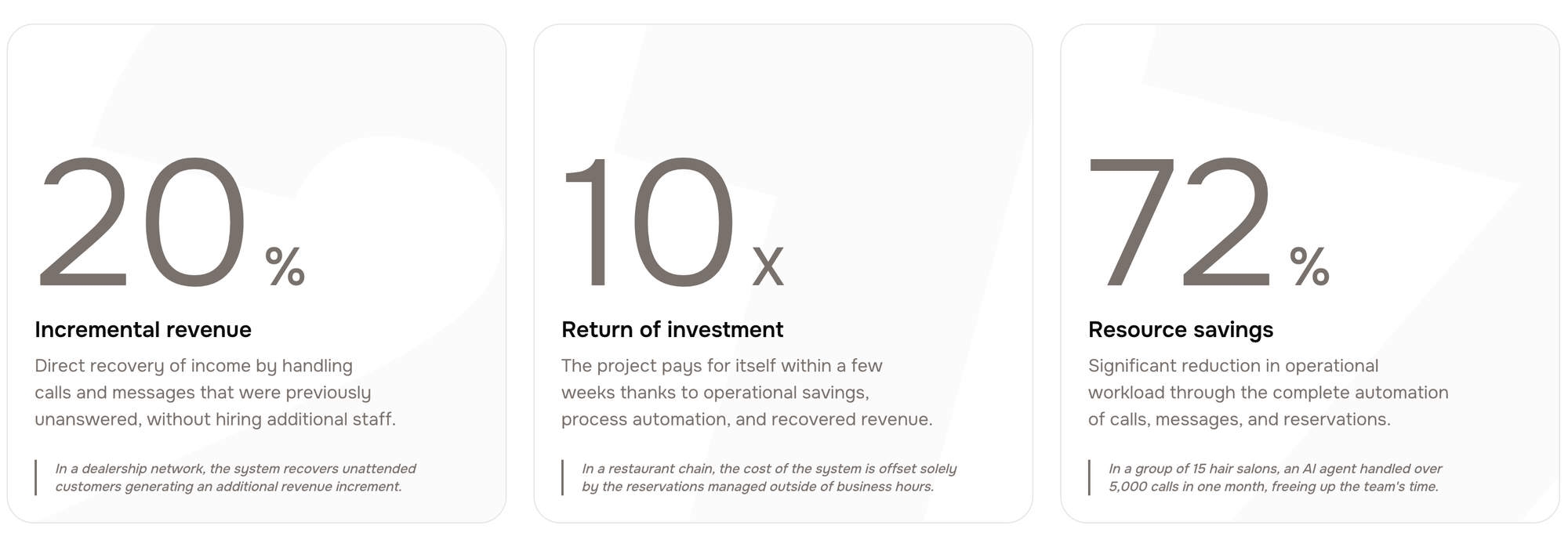
That makes it easier to plan capacity, adjust shifts and understand where the real bottlenecks sit. Often, this also means fewer no-shows, better use of available capacity and, ultimately, more revenue with the same staff.
In chains or groups, having this consistency between centres allows for fair comparisons and for successful practices in one location to be transferred to others.
Better experience for teams
The emotional and cognitive burden of constantly monitoring the phone is high. It is especially visible in salons, busy restaurants or workshops where people are already working with their hands.
By handing over the most repetitive, rule-based tasks to a voice agent, the human team can focus on cases that truly require judgement, empathy or negotiation.
That reduces stress, simplifies training (particularly in environments with many services and rules) and frees up time to improve the in-person experience for the clients who are already on site.
Conversations that become learning opportunities
Every call and every message can be read as data about the business: why appointments are cancelled, what creates doubt, what kinds of requests appear just after a marketing campaign goes live.
When that information is organised, the conversation moves away from pure feeling (“lately people seem to be calling a lot about…”) and towards evidence. That helps both the people in charge of operations and the teams designing campaigns, content and offers.
Over time, the combination of automation plus insight becomes a competitive advantage: the business not only answers more calls, it learns faster from them.
How collaboration with Heydiga usually begins
Getting started with Heydiga is simpler than it sounds.
Imagine a salon.
On a normal day it might receive something like:
- 80 calls in total
- 40–50 about bookings or changes
- 20–30 with questions about services, prices or availability
- And easily 15–20 missed calls, because the team is with clients or the calls arrive outside opening hours
With Heydiga, the starting point is always the same: make sure the agent really understands how the business works.
1. Teach the agent your business
The salon shares a few essentials with Heydiga:
- Services and durations
- Who does what in the team (for example, who can do colour, who only does cuts)
- Basic rules (gaps between treatments, how to combine services, when not to overbook)
- Practical information: products, styles, prices, location, opening hours
In a short setup, the agent has a clear picture of how the salon operates.
2. Route calls and messages to Heydiga
Once that is in place, the salon routes its calls and messages to Heydiga:
- The voice agent answers every call
- Understands whether it is a booking, a change, a question or something else
- Checks real availability in the calendar
- Books an appointment with the client’s preferred hairdresser when they are free
From that point on, the team can focus on the people in the chairs instead of juggling the phone.
3. Review the day in a few minutes
At the end of the day, the owner or manager can see, in about five minutes:
- How many calls and messages came in
- How many bookings were made or recovered
- Which conversations need a more personal follow-up
- An estimate of the time and revenue saved by picking up every call
The same pattern applies to a restaurant with DigaFood or a workshop with DigaMotor: set the rules, connect the calendar, let the agent handle routine conversations and keep the human team for the moments where they add the most value.
Not sure if it will sound natural?
Many teams share the same two worries: that a voice agent will not sound natural enough, and that onboarding will be complex or time-consuming.
If that is on your mind, the easiest next step is a quick conversation.
Book a short call with us and we will walk you through a live example, show you how the agent sounds with real calls, and explain how the setup would look for your salon, restaurant or workshop. No commitment, just a clear picture of what Heydiga could do in your context.