
How do multi-location clinics handle calls and appointments without losing control?

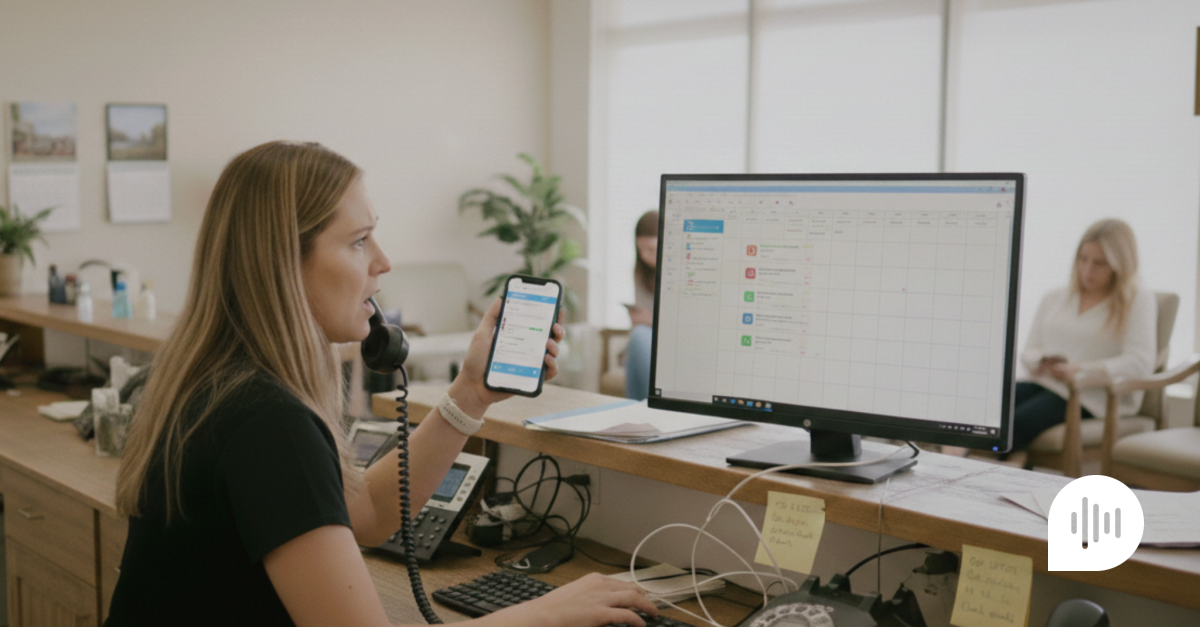
Clinics with multiple locations don’t fall into disorder overnight. They fall into disorder little by little.
When you only have one site, a lot of things sort themselves out. People know each other. Reception knows which professional works best with which type of appointment. If someone gets a policy wrong, it’s corrected in five minutes over a quick conversation.
It works because there’s shared memory.
Then you open the second site. Then the third.
And one day you realise something: each site handles things differently. Not out of bad intention, but because each team ends up inventing its own way of doing things.
Calls land in different places.
WhatsApp messages get spread between several people.
Calendars look similar, but they’re not the same.
Policies depend on who answers.
None of this sounds serious on its own. The problem is the combination.
In a group of clinics, reception stops being “picking up the phone”. It becomes coordination. Avoiding mistakes. Maintaining a single standard. And that’s when the question appears that nobody wants to answer too quickly: how do you automate without losing control.
Why patient communication breaks first in multi-location clinics
In these environments, volume usually isn’t what hurts most. What hurts is inconsistency.
One site explains cancellations calmly. Another delivers them like a legal clause. In physiotherapy they allow appointments to be moved easily. In aesthetics they’re stricter. Even pre-appointment instructions change depending on who answers: what documents to bring, what time to arrive, whether you need to come fasting.
Over time, those differences show. The team gets frustrated. And the patient feels that every call is a lottery.
Standardising doesn’t mean introducing scripts. It means agreeing, in writing, how the clinic works. And making sure it doesn’t depend on someone remembering.
When services, durations, availability and policies are clear, the tone changes by itself. There’s less improvisation. Less “I think so”. Fewer internal doubts.
Calls, WhatsApp and appointments: what happens when they’re split across tools
If you’ve seen a reception desk at peak hour, you already know what fragmentation looks like.
Phone ringing. WhatsApp open. Calendar on another screen. A note written down somewhere “for later”.
A patient calls to move an appointment. Later they send a message to confirm. Then they ask something about a previous treatment. If each part lives in a different tool, someone has to reconstruct the story by hand.
That’s invisible work. And it’s more tiring than it looks.
When calls, messages and the diary live in the same place, less context gets lost. You don’t have to guess what happened. You can see what was moved, what’s still pending, which conversation remains open.
For a group of clinics, that isn’t “nice to have”. It’s the difference between constantly putting out fires and being able to operate calmly.
How to automate appointment booking and rescheduling without breaking the diary
This has to be said clearly: the diary is sacred ground.
If scheduling fails, the day collapses. And that’s why anything that sounds like automation makes people nervous.
Good automation doesn’t improvise. It respects availability per professional, real resources, correct durations. It records changes. It avoids double bookings and phantom gaps.
In one single site, you survive small ambiguities. In five sites, you don’t.
How clinic groups reduce no-shows: remove friction from confirmations and changes
It’s easy to think people don’t turn up because they forget. Sometimes they do. But often it’s friction.
If changing an appointment means calling, waiting, calling again, or sending messages nobody confirms, people put it off. And then they arrive late or simply don’t show up.
When confirming, moving or cancelling is easy within the same thread, behaviour changes. Not because people are better. Because the process stops fighting them.
What clinic groups should measure: call volume, appointment changes, and no-shows by location
As soon as you grow a little, management eventually asks: what’s really happening at reception?
Without visibility, the answer is usually “we’re flat out”. Which may be true, but it doesn’t help much.
When you can see how many calls come in, how many are answered, how much time is spent, how many appointments are created or moved, the conversation shifts. It’s no longer a feeling. It’s something you can understand and improve.

It’s not about replacing people
In healthcare there’s always caution when AI enters the conversation, and that makes sense.
But this isn’t about removing empathy. It’s about removing repetitive interruptions.
Bookings, changes, confirmations, basic queries, policies.
If that block is handled by a well-configured system, the team can focus on what genuinely requires human judgement. And in a group of clinics, that difference shows quickly.
There’s another thing that often gets misunderstood.
Patients don’t actually care whether a human or a system answers first. What they care about is whether their question gets resolved properly. Whether they can change an appointment without hassle. Whether they get a clear answer. Whether the interaction feels smooth and professional.
If an AI handles that well, without confusion, without back-and-forth, without dead ends, then the friction is almost zero. And when friction is low, people are content. They move on with their day.
The frustration never came from “who answered”. It came from delays, uncertainty, and having to repeat yourself.
When that disappears, resistance tends to disappear with it.
Where Heydiga fits: a 24/7 AI agent
This is exactly the gap Heydiga is designed to cover.
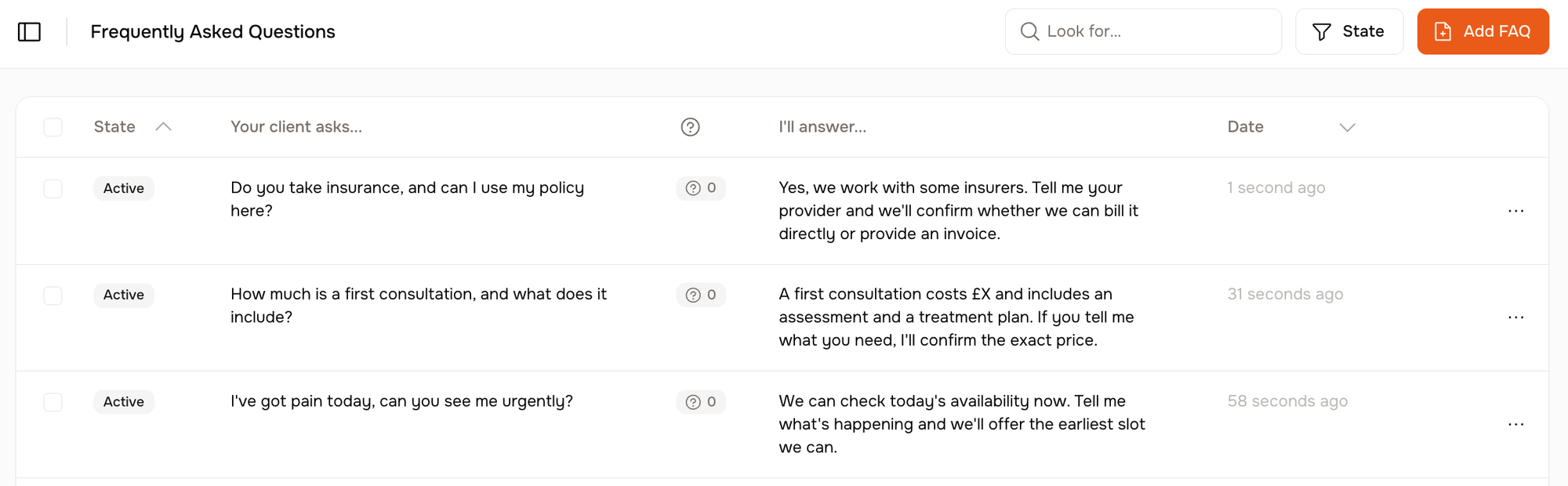
Heydiga is a 24/7 AI agent that handles patient calls and messages and can deal with the routine work clinics don’t want to be doing all day: booking appointments, moving them, confirming them, answering the same questions, applying the clinic’s own policies consistently.
Behind that agent sits a control console where the clinic’s context lives. That’s where you define services, durations, opening hours, team availability, FAQs and the rules that usually end up scattered across people’s heads. It’s also where you can see what happened: what was booked, what was changed, what stayed pending, and which conversations are still open.
So the front line feels simple for the patient, but the clinic keeps visibility and control.