
How much does a missed call really cost a local business?


After speaking with dozens of local business owners, a very similar pattern keeps coming up. In a small business like a hair salon, a restaurant, or a workshop, it’s common to receive around 20 to 30 calls a day.
Not all of them get answered. Even in well-run places, it’s typical to see around five calls per day go unanswered simply because the team is busy, the timing is bad, or the call comes in at an awkward moment.
That alone adds up quickly. Five missed calls a day can become roughly 100 to 150 missed calls a month, depending on how many days the business is open. Over a year, that’s well over 1,200 attempts to reach your business that didn’t turn into a conversation.
Now put a conservative average ticket next to it: €20–25.
Even if only a portion of those callers were ready to book, order, or confirm something, this stops being a minor issue very quickly. You’re talking about a problem that can quietly translate into tens of thousands of euros per year in missed revenue potential.
Below, we look at what those missed calls really mean in practice, why they keep happening, and what changes when they’re actually handled.
What missed calls add up to over time
When people think about missed calls, they often assume the customer will simply try again later. Sometimes that happens. But in service businesses, many calls are made with momentum: someone is choosing between options, checking availability for today, or trying to solve a concrete doubt before deciding.
Studies on customer behaviour, including research discussed by Harvard Business Review, consistently point to the same pattern: when people don’t get a response at the moment they reach out, the likelihood of them trying again drops sharply. In services, timing matters more than persuasion.
This is why missed calls behave less like “delayed demand” and more like “lost demand”. The opportunity often disappears with the moment.
And because calls tend to peak during busy hours, the ones you miss are often the ones with the highest intent.
A realistic example: a small restaurant
Let’s make the maths tangible with a deliberately conservative scenario.
Imagine a small restaurant. Most calls come in around lunch and dinner service, exactly when answering the phone is hardest.
Assume:
- 14 missed calls per week
- Average ticket: €30
- 40% of those callers had clear intent to book or order
That gives you roughly:
- 6 potential customers per week
- €180 per week
- Around €9,000 per year
This isn’t meant to be an exact number. It’s meant to show how quickly missed calls stop being negligible once you look at them over a full year. Many businesses miss more calls than this, operate more days per week, have higher tickets, or benefit from repeat visits after the first booking.
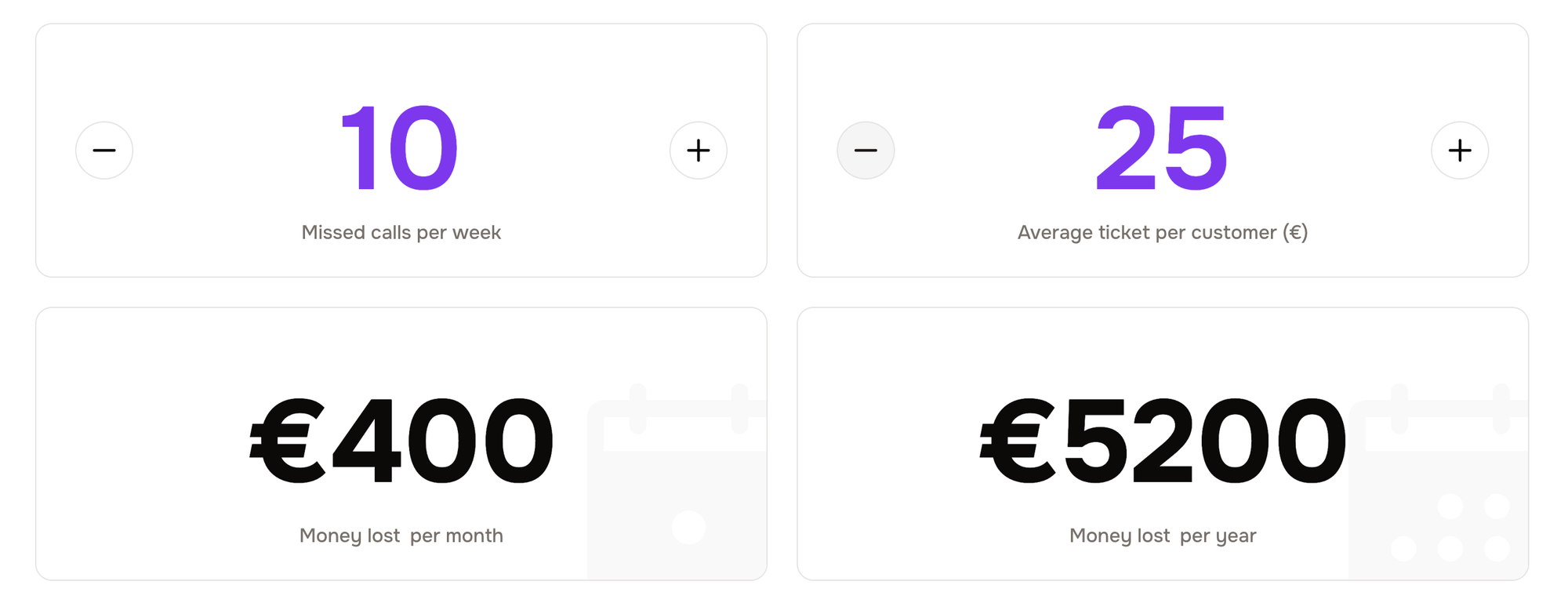
At that point, the question isn’t whether missed calls matter. It’s how much they matter in your specific case.
The part that doesn’t show up in the numbers
Lost revenue is only part of the cost.
Missed calls usually happen when the team is already under pressure. And even when a call is answered, it often interrupts work mid-way. The hidden cost isn’t just the minute spent on the call, but what comes after.
Research on workplace interruptions, including well-known studies from the University of California, Irvine, shows that the real impact of an interruption is the time and mental effort required to regain focus and return to the original task.
In a service environment, this tends to show up as:
- fragmented attention during treatments or service
- slower execution when tasks are interrupted
- avoidable mistakes
- accumulated stress that builds throughout the day
Then there is the quiet administrative work that follows:
- returning calls later, often without full context
- checking calendars again and again
- relying on memory instead of systems
- conversations that never fully close
Over time, this shapes how the business operates and how it feels to work in.
Why this keeps happening
Most local businesses aren’t short on effort or care. The issue is structural.
Communication, availability and rules often live in different places:
- calls on the phone
- messages on WhatsApp
- availability in a calendar
- rules in someone’s head
When these elements aren’t connected, every call becomes a small decision-making exercise. And decision-making does not scale well when you’re busy.
This is why missed calls remain common even in businesses that are otherwise well run.
Where Heydiga fits into this picture
Heydiga was built around this exact reality.
Instead of forcing teams to choose between serving the person in front of them and answering the phone, Heydiga handles calls and messages using the way the business actually works: its services, availability, rules and team setup.
Calls don’t disappear. They get handled.
Bookings, changes and cancellations happen without interrupting service, and the calendar stays up to date as those interactions happen.
The important shift isn’t that “AI answers the phone”. It’s that customer interactions stop depending on memory, timing and stress, and start behaving like part of the operation. Heydiga is another member of your team working for you 24/7.
Missed calls are invisible losses
Missed calls are easy to ignore because nothing breaks when they happen. There’s no alert, no error message, no obvious failure.
Until you step back and do the maths.
If you’re curious what this looks like for your own business, we built a simple calculator where you can plug in your numbers and see the impact in under a minute.