What is the difference between AI that assists and AI that does the work?


There’s a big shift happening in how AI is actually used inside businesses.
Most people don’t talk about it this way, but it’s quite simple. There are two types of AI products today. The ones that help you do things, and the ones that actually do the work for you.
On paper, the difference feels small. In practice, it changes how a business runs.
Why do most AI tools still need human input to work?
If you look at most tools people use today, they sit in the “assistant” category.
They help you write faster, analyse things quicker, or generate ideas. That’s useful. But the structure of the work doesn’t really change. Someone still needs to read, decide, and act.
Even in more advanced setups, the pattern is the same. The AI produces something, and a person validates it before anything happens. It’s a loop that still depends on human availability.
That’s why most AI adoption so far feels like optimisation. Things move faster, but the system itself is still the same.
What does it mean for AI to actually do the work?
The second category works differently.
Here, the goal is not to assist, but to handle. The AI takes care of a task from start to finish, and only involves a person when something falls outside the expected flow.
In a service business, that looks very concrete. Calls get answered, bookings get scheduled, questions get resolved, and follow-ups happen without someone needing to step in every time.
There’s no prompt, no “review before sending”, no constant supervision. The work simply happens.
This is what people usually mean when they talk about AI agents, but the important part is not the label. It’s the fact that part of the operation is now running without depending on a person being available constantly.
Are AI agents actually more efficient than copilots?
There is now some data that helps explain this difference.
A recent Stanford study looked at real AI deployments inside companies and found a clear pattern. Systems that require constant human approval tend to deliver around 30% productivity gains. Systems that run more autonomously and only escalate exceptions get closer to 70%.
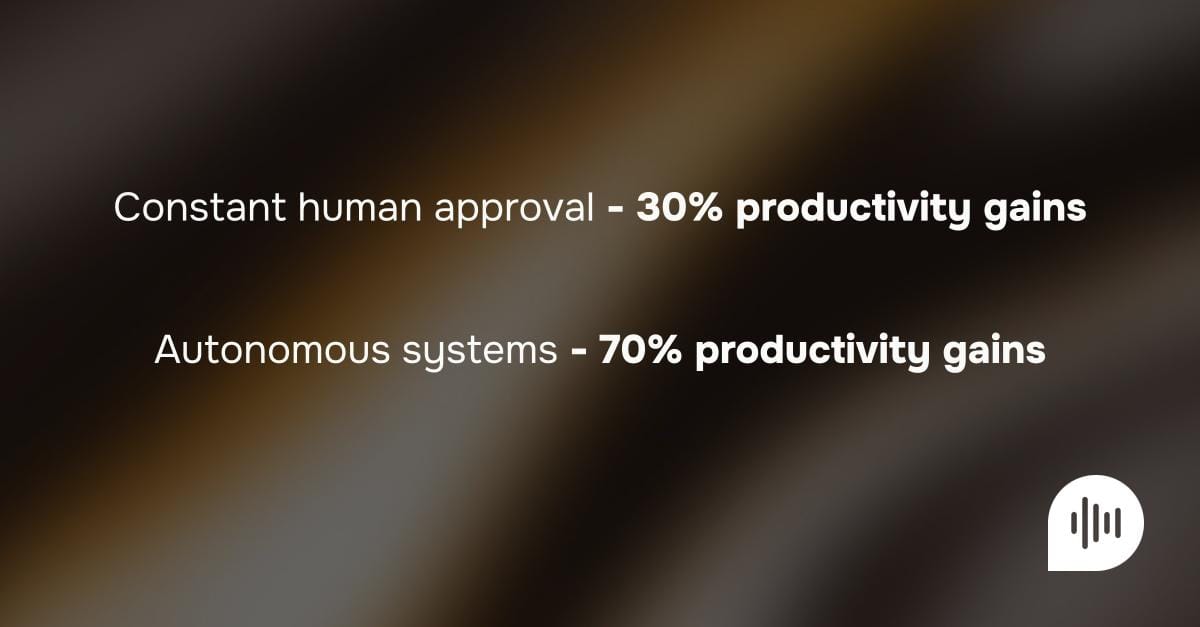
That gap is not coming from better models. It comes from removing the need for a person to be in every step of the process.
Once you see it that way, the numbers make sense. If every interaction still needs attention, you save time. If most interactions don’t, you free up capacity.
How much work can AI agents handle in practice?
This is where people usually get sceptical.
The assumption is that AI needs to be almost perfect to be useful. But that’s not how it plays out in real environments.
In our case at heydiga, our agents are already solving around 88.6% of interactions without human intervention. The remaining percentage gets escalated.
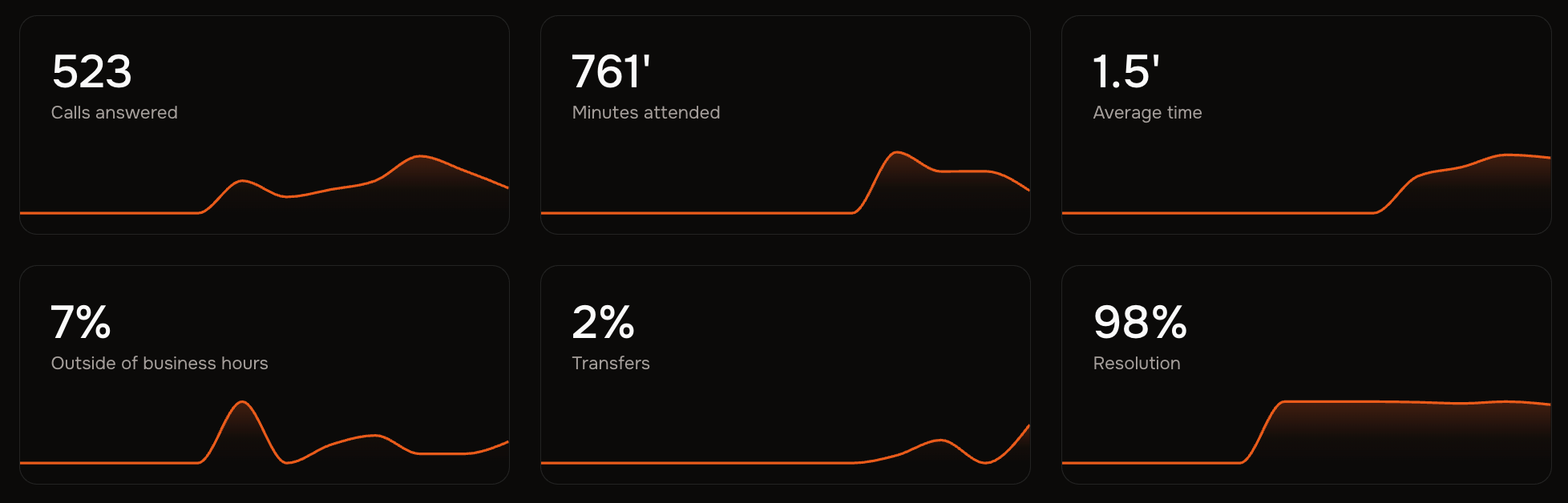
That balance is enough to change things. Most of the volume gets handled without friction, and the team focuses on the cases that actually need judgement.
Why does this change how a business operates?
The impact doesn’t come from one big improvement. It comes from a series of small shifts that compound.
When part of the work is handled automatically:
- Teams are interrupted less often
- Customers don’t wait for responses
- Requests get handled at the moment they happen
- The same type of interaction gets resolved consistently
None of this sounds dramatic on its own. But together, it changes the pace of the day.
Work stops depending entirely on who is available and when.
Why are more businesses moving in this direction?
Because the pressure is already there.
Most service businesses are dealing with more incoming requests, more channels, and less time to handle each interaction. The team is already stretched, and the volume doesn’t stop.
Adding tools that help is useful, but it doesn’t solve the underlying problem. The work is still there, waiting to be done.
At some point, the question changes from “how do we do this faster?” to “how do we stop needing to do all of this manually?”
That’s when the model starts to shift.
Is AI about helping people, or changing how work gets done?
Framing it as “AI replacing people” misses the point.
What’s actually happening is simpler. Some parts of the work don’t need constant human involvement, and now there’s a way to handle them differently.
When AI is used as an assistant, the system stays the same and just gets more efficient.
When AI starts handling tasks on its own, parts of the system get rebuilt around that capability.
And then people are free to work on what actually matters for the business.
That’s the difference.
If you would like to see how our agents works in practice, you can simply call the number +18578105872 and ask a couple of questions yourself!