
How can I stop missing customer calls?


The simplest way to stop missing customer calls is to make sure every call has somewhere useful to go. That may mean better call routing, a clear callback process, online booking or an AI voice agent that can answer when your team cannot.
The right answer depends on why the calls are being missed. If it only happens occasionally, a basic process may be enough. If the phone rings while your team is serving customers, after hours or across several locations, the problem is usually structural. You need a system that can answer, understand the request and complete the next step without waiting for someone to become free.
Why do businesses miss customer calls?
Usually, it's not because nobody cares. It's because the call arrives at exactly the wrong moment.
- A restaurant is in the middle of service.
- A stylist has both hands busy.
- A mechanic is under a car.
- A clinic receptionist is helping the person at the desk.
- The business is closed, but the customer is ready to book.
- Two or three people call at the same time.
The phone still matters because customers often call when they want a quick answer. They may be checking availability, changing an appointment, asking about a service or trying to solve a small doubt before they decide.
The problem is that those high-intent calls tend to arrive during the busiest parts of the day. The moments when the business is most valuable to customers are often the moments when the team is least able to pick up.
What happens after a customer call is missed?
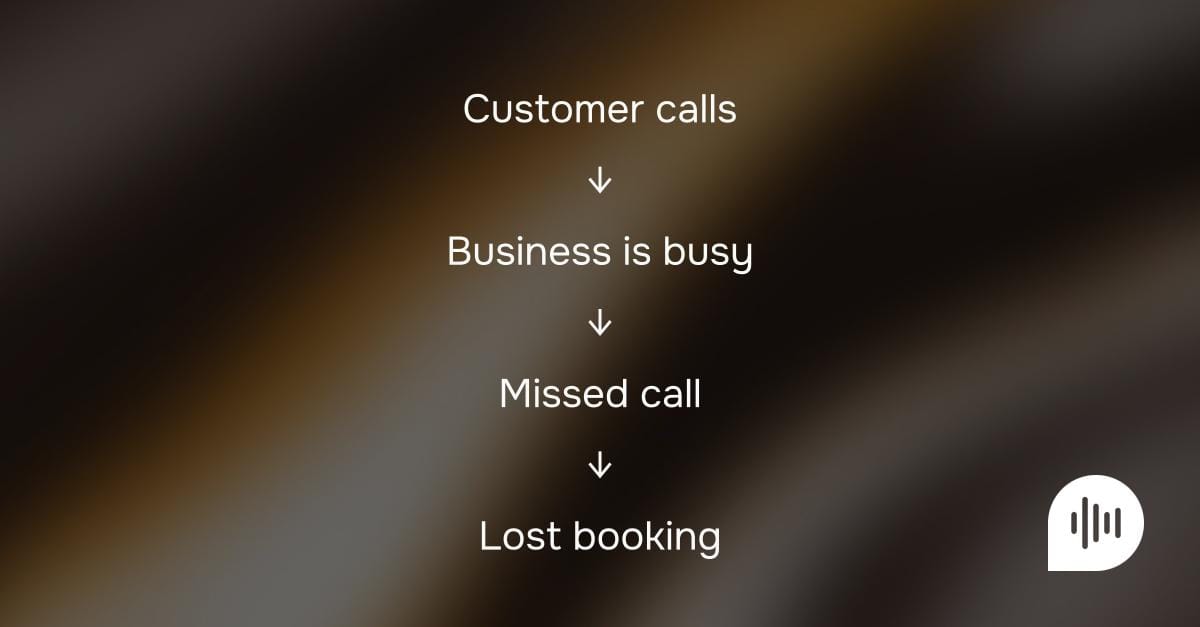
Sometimes the person calls back. Sometimes they leave a message. Sometimes they contact you on WhatsApp.
And sometimes they simply call the next business.
That is what makes missed calls hard to measure. Nothing visibly breaks. The phone stops ringing and the day continues. But behind that call there may have been a booking, an order, an appointment or a customer who needed reassurance before choosing you.
There is also a second cost: the work created afterwards. Your team has to check the missed call, find a quiet moment, call back, recover the context and update the calendar. By then, the customer may no longer answer or may already have found another option.
Related reading: How much does a missed call really cost a local business?
How can you stop missing customer calls?
There is no single fix for every business. Start with the simplest option that solves the real cause of the problem.
1. Make ownership clear
Someone should know who is responsible for incoming calls at each point of the day. “Whoever is free” sounds flexible, but it often means nobody is truly responsible.
Best for: Small teams with predictable call volume.
2. Use call forwarding or routing
Send calls to another person, location or device when the main line is busy. This can reduce missed calls, but it does not help much if everyone is busy at the same time.
Best for: Businesses with several available team members.
3. Set a real callback process
Define how quickly missed calls should be returned, who does it and where the outcome is recorded. A callback list is only useful if somebody owns it.
Best for: Low-volume businesses where calls are not urgent.
4. Give customers another way to complete simple tasks
Online booking and clear website information can remove some repetitive calls. They work well for people who already know what they need, but many customers still call when the request is urgent or unclear.
Best for: Simple, standardised bookings and FAQs.
5. Cover calls outside opening hours
A voicemail can collect a message, but it still leaves the work for later. If customers regularly call in the evening or at weekends, the better solution is one that can answer questions or complete a booking there and then.
Best for: Businesses receiving demand outside working hours.
6. Use an AI voice agent (recomended)
An AI voice agent can answer calls when the team is busy or when the business is closed. It understands why the person is calling and carry out common tasks such as booking, rescheduling, answering questions or collecting details.
Best for: Busy service businesses, multi-location groups and teams with repetitive calls.
Which solution is right for your business?
The useful question is not “Which tool has the most features?”. It is “What needs to happen when nobody can answer?”.
| Option | What it does | When the customer gets help | Scalability | Best for |
|---|---|---|---|---|
| Voicemail | Records a message | After the call | Low | Very occasional missed calls |
| Call forwarding | Moves the call to another person | During opening hours | Low to medium | Teams with spare capacity |
| Callback process | Organises follow-up | Later | Low | Low call volume |
| Online booking | Lets customers self-book | 24/7 | Medium | Simple, standard bookings |
| AI voice agent | Answers, understands and completes tasks | 24/7 | High | Busy or multi-location service businesses |
When does an AI voice agent make sense?
An AI voice agent is useful when the problem is not the phone itself, but the fact that answering it depends on a person being available at the exact right moment.
It is worth considering if:
- you miss calls while the team is serving customers
- the same questions come up every day
- customers call outside opening hours
- bookings, cancellations and reschedules take up a lot of time
- you have several locations and want calls handled consistently
- your team spends part of every day returning calls
It may be excessive if you only miss one or two low-priority calls a month. In that case, a better callback routine may solve the problem.
The point is not to automate every conversation. It is to remove the repetitive work and make sure common requests are handled when the customer is ready.
What should an AI phone agent be able to do?
A useful AI phone agent should do more than pick up and take a message. It should understand the business well enough to move the conversation forward.
| Capability | Why it matters |
|---|---|
| Answer naturally | Customers should be able to speak normally, without following a rigid menu. |
| Understand intent | It should recognise whether the person wants to book, change, cancel, ask a question or speak to someone. |
| Use real business information | Opening hours, services, prices, availability and policies should come from a reliable source. |
| Complete common tasks | The call should end with a booking, an update, an answer or a clear next step. |
| Know when to hand over | Unusual, sensitive or unclear situations should reach a person. |
| Leave a clear record | The team should see why the customer called and what happened. |
How does Heydiga help businesses answer every call?
Heydiga connects customer conversations with the way the business actually works.
The agent can answer phone calls and WhatsApp messages, understand the request and follow the rules defined by the business. Depending on the setup, it can handle bookings, cancellations, reschedules, common questions and information collection.
The important part is not that an AI answers the phone. It is that the customer gets a useful outcome and the team gets a clear record without being interrupted.
For a restaurant, that may mean confirming a table while the team is in service. For a salon, it may mean moving an appointment while the stylist is with a client. For a workshop, it may mean collecting the vehicle details and finding a suitable slot without pulling a technician away from the job.
Calls stop depending on luck, timing and somebody remembering to call back.
See how Heydiga works.
How can you tell whether the problem is improving?
Do not judge the system by whether the phone sounds quieter. Look at what happens to the calls.
- How many calls are answered?
- How many requests are resolved without a callback?
- How many bookings happen outside opening hours?
- How much time does the team spend returning calls?
- How many calls need to be transferred to a person?
- Are customers still repeating the same information?
A good setup should reduce interruptions without making the customer experience colder or more complicated. Customers should get an answer faster. The team should have fewer loose ends at the end of the day.
A practical first step
Before buying anything, look at one normal week.
- Count how many calls are missed.
- Note when they happen.
- Write down the most common reasons people call.
- Check how many require a person and how many follow a repeatable process.
- Estimate how much time is spent calling people back.
That will tell you whether you need a small process change or a system that can actually handle the calls.
Frequently asked questions
Why do customers call instead of using online booking?
People often call when they are in a hurry, need reassurance or are not sure which option to choose. Online booking works well for simple requests, but a conversation is still useful when the customer has a question, a special requirement or wants availability for a specific time.
Should I use voicemail for missed business calls?
Voicemail is better than letting the call ring out, but it does not solve the request. The customer still waits, and your team still has to return the call. It can be enough for very low call volumes, but it becomes difficult to manage when calls are frequent or time-sensitive.
Can an AI answer calls for my business?
Yes. An AI voice agent can answer calls, understand common requests and follow business rules. Depending on the setup, it can book appointments, change reservations, answer questions, collect information or transfer the call when human judgement is needed.
Can an AI phone agent answer calls after hours?
Yes. One of the clearest use cases is handling calls when the business is closed. Customers can get information, make a booking or leave structured details without waiting until the next day.
Will an AI voice agent replace my staff?
That is not the goal. The best use is to handle repetitive and time-sensitive conversations so staff can focus on customers and situations that need judgement. A good setup also knows when to pass the call to a person.
What happens when the AI does not know the answer?
It should not guess. A reliable agent asks a clarifying question, records the request or hands the conversation to the right person. Accuracy matters more than pretending every call can be fully automated.
Is an AI voice agent only useful for large companies?
No. Small service businesses often feel missed calls and interruptions more sharply because every team member is already doing several jobs. Larger groups benefit from consistency across locations, but the underlying problem exists at both scales.