
How Real Estate Agencies Can Stop Losing Property Leads to Missed Calls

A property lead often calls from a listing when they are ready to act. They want to know whether the home is still available, whether it fits a specific requirement or when they can see it. If nobody answers, the next step is often simple: they return to the portal and call another agency.
Real estate agencies can reduce that loss by giving every enquiry a useful next step. The caller should receive an immediate answer, be qualified with a short set of relevant questions and, when appropriate, book a viewing while their interest is still fresh. The aim is not to automate the relationship. It is to make sure an agent starts the relationship with context instead of a missed-call notification.
Why do property leads call instead of filling in a form?
Property searches create questions that forms rarely answer. A buyer may want to confirm whether a terrace is private, whether the building has a lift or whether the seller would consider a particular completion date. A tenant may need to explain their employment situation before arranging a viewing. People also call because they are comparing several listings and want a quick signal that one is worth pursuing.
The call therefore carries more than contact details. It reveals urgency, intent and the concern standing between the lead and the next step. A form can collect a name and email address. A good conversation can establish whether the property fits, whether the person is ready to move and what should happen next.
What happens when agents are in viewings or meetings?
The phone often rings when the team is least able to answer it. Negotiators are showing properties, branch managers are in valuation meetings and the person in the office is already speaking to another client. After hours, the agency may be closed while prospective buyers and tenants finally have time to browse listings.
The operational problem begins after the ring stops. Someone has to identify the listing, call the person back, recover the context and find out whether they are still interested. If several agents share a branch phone, ownership can be unclear. If the enquiry arrived through a portal, the caller may already have contacted other agencies before the first callback happens.
Research on online sales enquiries points in the same direction. A Harvard Business Review audit of 2,241 US companies found that firms attempting contact within an hour were nearly seven times as likely to qualify a lead as those waiting longer than an hour. The study was published in 2011 and was not specific to real estate or telephone enquiries, so it should be treated as evidence about response speed, not as a property-call conversion benchmark. Read the Harvard Business Review study
Related reading: How can I stop missing customer calls?
Speed matters, but the answer should also be useful. Picking up only to say that an agent will call later does not move the enquiry forward. The better outcome is to capture what the person needs and complete the next sensible action.
How can an agency qualify a lead without wasting the agent’s time?
Qualification should be brief enough to feel like a conversation and specific enough to help the agent. The purpose is not to interrogate every caller or decide their value before a human speaks to them. It is to establish fit, readiness and the appropriate next step.
| Question | What it establishes |
|---|---|
| Are you looking to buy or rent? | The correct process, team and property criteria. |
| Which area are you considering? | Location fit and possible alternatives. |
| What is your budget? | Whether the enquiry matches the listing and available stock. |
| What type of property do you need? | Bedrooms, use, features and non-negotiable requirements. |
| When do you want to move? | Urgency and likely decision timeline. |
| Have you arranged financing? | Whether a buyer is ready to proceed or needs guidance. |
| When could you attend a viewing? | The fastest route from interest to a confirmed appointment. |
Not every question belongs in every call. A rental enquiry may require basic eligibility information. A buyer asking about a specific home may only need availability confirmed before a viewing. The flow should adapt to the listing and the agency’s rules, then leave the agent with a concise record rather than a transcript they have to decode.
Can a viewing be booked during the first call?
Yes, when the property is available, the caller meets the agency’s requirements and the calendar is connected to the enquiry process. The caller can be offered suitable times for the agent responsible for that listing, choose one and receive confirmation without waiting for a callback.
This is where qualification becomes operationally useful. The conversation does not end with “we will get back to you”. It ends with a booked viewing, a structured follow-up or a clear handover. DigaLiving is designed to connect property enquiries with the agency’s live information, CRM and calendars so the next step can happen during the conversation.
Related reading: How to automate bookings with AI agents without harming customer service
Related solution: DigaLiving for property businesses
When should the call go to a human immediately?
Some conversations should not be automated beyond the first few seconds. A caller may be making an offer, negotiating terms, raising a complaint, discussing a sensitive financial situation or reporting an urgent safety issue at a managed property. These calls require judgement, reassurance or authority.
The system should recognise those situations and transfer the call according to clear rules. If the right person is unavailable, it should collect the essential context, mark the priority and confirm what will happen next. It should never invent an answer about price flexibility, legal conditions, financing or a property detail it cannot verify.
How does WhatsApp follow-up fit after the call?
WhatsApp is useful for turning the spoken conversation into something the lead can act on. After a viewing is booked, the agency can send the time, address, agent’s name and any documents or instructions the person needs. If no appointment was made, the follow-up can confirm the criteria discussed and share suitable next steps.
It also removes avoidable repetition. The caller should not have to explain their budget, preferred area and timing again when the conversation moves to WhatsApp or reaches an agent. The call record and the follow-up should form one continuous enquiry, not two separate inboxes.
What should real estate agencies measure?
The goal is not simply to reduce missed calls. Agencies should understand whether enquiries are being answered, qualified and converted into scheduled viewings.
| Metric | What it reveals |
|---|---|
| Calls answered | Whether incoming demand receives an immediate response. |
| Qualified leads | How many callers match the agency’s criteria or available stock. |
| Viewings booked | Whether conversations become concrete next steps. |
| Time to first response | How long a high-intent lead waits before the agency engages. |
| Leads outside office hours | How much demand arrives when the branch is closed. |
| Human transfers | Which enquiries require judgement and whether routing rules work. |
Useful metrics include calls answered, qualified leads, viewings booked, response times and enquiries received outside office hours. Heydiga turns conversations into structured data that helps agencies identify what callers ask about, which opportunities require follow-up and where the enquiry process can be improved. These insights can be combined with CRM and appointment data to evaluate the complete journey from first call to scheduled viewing.
What does the workflow look like in practice?
Imagine someone finds a flat on a property portal on Sunday afternoon and calls the number in the listing. The agency is closed, but the call is answered immediately. The caller confirms that they want to buy, names the property and asks whether it is still available.
The agent checks the listing information, confirms availability and asks for the buyer’s preferred timing, budget and financing status. The buyer is ready to proceed and can attend on Tuesday or Thursday. The connected calendar shows two suitable slots with the negotiator responsible for the property. The buyer chooses Thursday at 18:00 and receives the confirmation on WhatsApp.
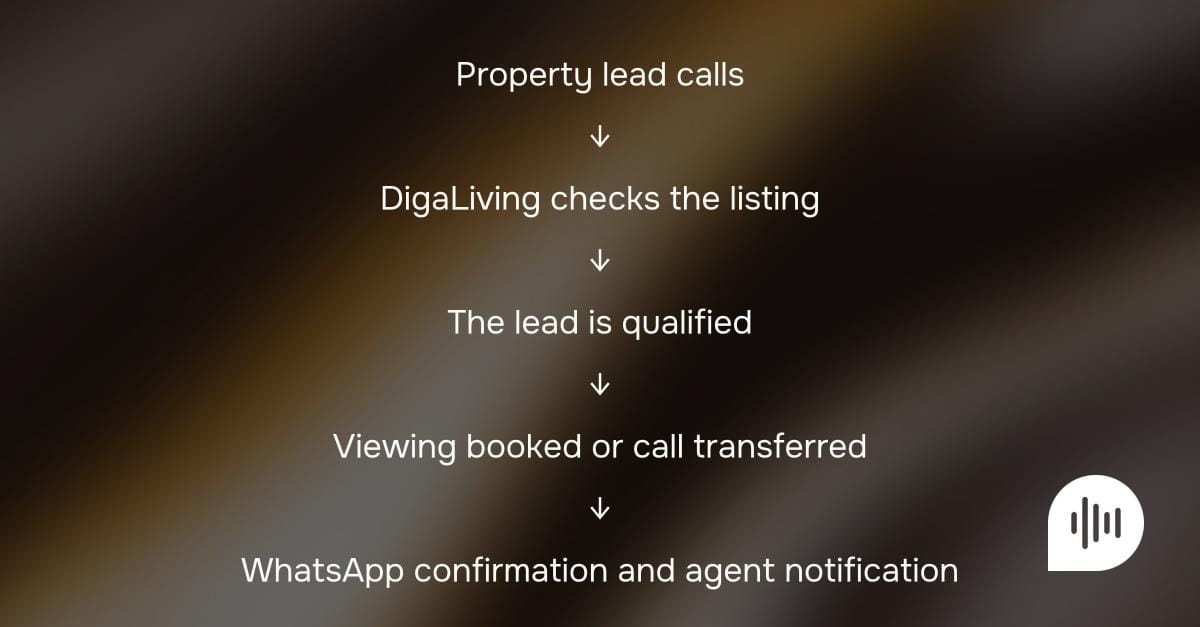
The negotiator begins Monday with a qualified lead, the property reference, the caller’s criteria and a confirmed viewing. If the caller had asked whether the seller would accept a lower offer, the conversation would have been flagged for the negotiator instead of guessing. This example reflects the operating flow presented by DigaLiving; it is illustrative, not a claim that every enquiry follows the same path.
A practical first step for your agency
Review one normal week of incoming calls before changing the process.
- Count answered and missed calls by hour and day.
- Identify which listings and channels generate the most calls.
- Write down the questions agents ask before arranging a viewing.
- Separate routine enquiries from calls requiring judgement or negotiation.
- Check how long it takes to return missed calls and how many become viewings.
- Define the information an automated agent may use and the situations it must transfer.
This gives you the basis for a useful call flow. Start with the enquiries your team handles repeatedly, connect the correct listing and calendar information, and test the handover rules before expanding the system.
Frequently asked questions
Why are missed calls especially costly for estate agencies?
Property callers are often comparing active listings and want a quick answer before deciding what to view. A missed call can therefore interrupt a decision already in progress. Even when the person calls back later, the agency must recover the context and may find that another viewing has already been arranged elsewhere.
Can an AI receptionist qualify property leads?
Yes. It can ask agreed questions about buying or renting, area, budget, property type, timing, financing and viewing availability. The questions should change according to the enquiry and the agency’s rules. Qualification should prepare the agent, not create an unnecessary barrier for the caller.
Can it identify the property someone is calling about?
It can when the call source, property reference or connected listing information makes the property identifiable. If the listing is unclear, it should ask for the address or reference and confirm the match before giving information. It should not guess which property the caller means.
Can it book property viewings after hours?
Yes, if it has access to current availability and the relevant agent’s calendar. It can offer approved times, confirm the appointment and send the details to the lead. More complex requests can be recorded for a human follow-up instead.
What information should never be improvised?
Availability, price, property details, rental requirements, financing, legal conditions and negotiation positions should come from approved information or a human agent. If the answer is uncertain, the system should clarify, record the question or transfer the call.
Will this replace estate agents?
No. Its useful role is to answer routine enquiries, collect context and complete administrative next steps when the team is unavailable. Agents remain responsible for advice, negotiation, relationships and decisions that require judgement.
Conclusion
Real estate agencies lose property leads when answering the phone depends on an agent being free at exactly the right moment. Better callbacks may help, but they still ask a high-intent caller to wait while the agency catches up.
A stronger process answers immediately, identifies the property, qualifies the enquiry and completes the next step. Routine calls can become booked viewings or structured follow-ups. Sensitive, uncertain and commercial conversations can reach a person with the context already captured.
Want to see how that workflow could operate in your agency? Explore DigaLiving